
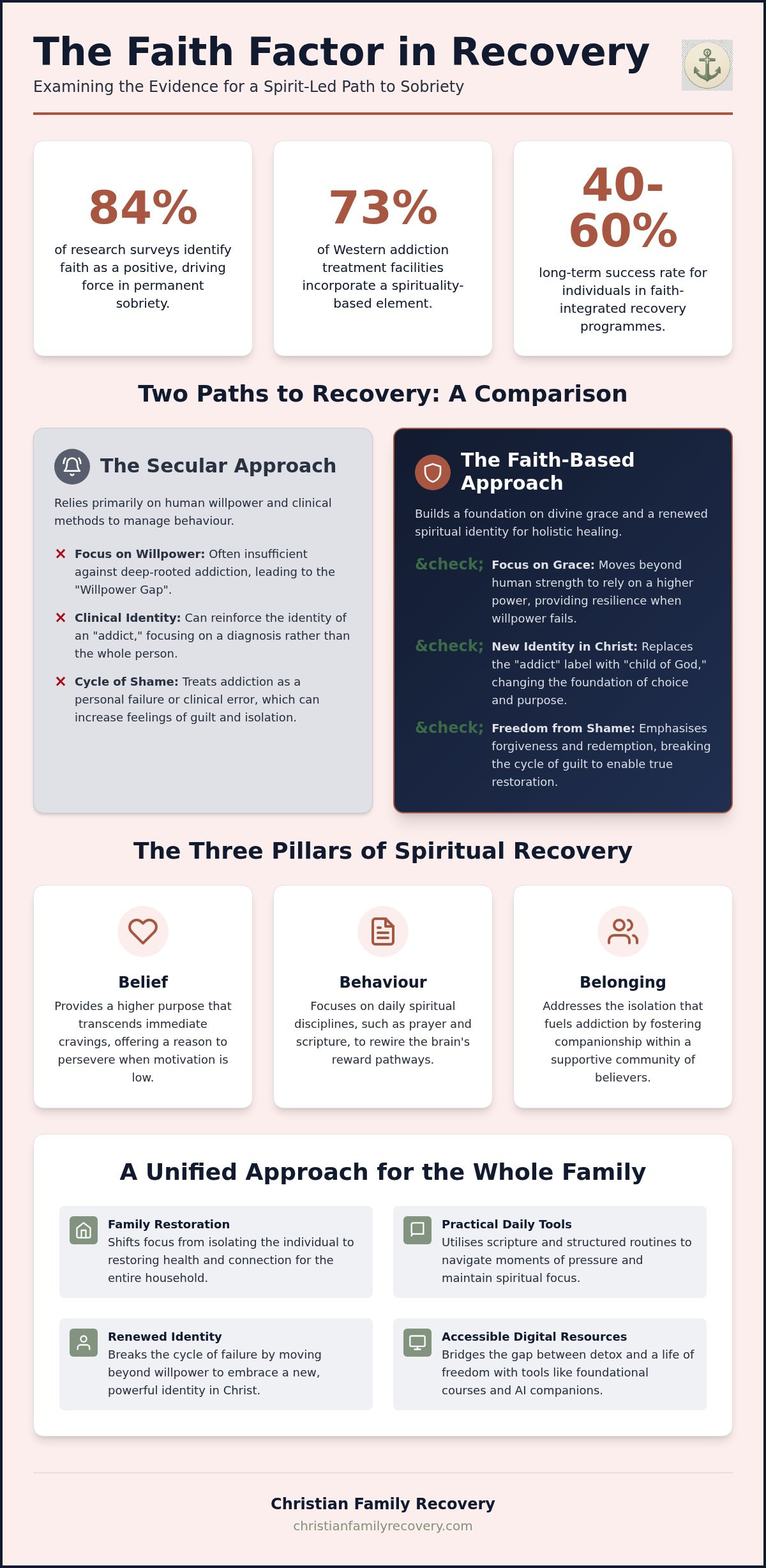
Did you know that 84% of research surveys identify faith as a positive, driving force in the journey toward permanent sobriety? When you are caught in the exhausting cycle of secular rehabs or feeling the heartbreak of a willpower that seems to fail every time, it is natural to ask: is faith-based recovery effective? You might feel isolated by traditional clinical models that treat the physical symptoms but leave the spirit feeling hollow and untouched.
We understand that deep ache for something more than just a temporary detox. This article provides the empirical evidence and spiritual foundations that make faith-based recovery a powerful, life-changing path to long-term restoration. We will look at the 2026 data on success rates and the recent shift in federal funding that recognises the value of spiritual care. Most importantly, you will discover a framework that combines spiritual growth with practical sobriety. We want to help you move from a state of crisis toward a vision of stability, healing the whole family whilst replacing the identity of struggle with a new identity in Christ. There is a path forward, and you do not have to walk it alone.
Key Takeaways
- Explore the latest 2026 research to understand why faith is considered an indispensable element of healing and find out exactly why is faith-based recovery effective for long-term sobriety.
- Discover how moving beyond simple willpower to embrace a new identity in Christ can break the cycle of repeated failure that many secular programmes don't address.
- Learn the importance of a unified family approach, where the focus shifts from isolating the individual to restoring the health and connection of the entire household.
- Gain practical tools for daily life, including how to use scripture and structured routines to navigate moments of intense pressure and maintain your spiritual focus.
- Understand how accessible digital resources, such as an 8-Week Foundational Course and a Personal AI Companion, can bridge the gap between clinical detox and a life of freedom.
The Science of Spirit: Examining the Evidence for Faith-Based Recovery
Faith-based recovery isn't just a collection of religious rituals; it's a holistic model that weaves spiritual health into the very fabric of behavioural change. Many families ask, is faith-based recovery effective, especially when they've seen traditional clinical methods fail to provide a lasting solution. The answer lies in the integration of the whole person. Recent 2026 recovery research highlights that faith is "indispensable" for many, providing the internal scaffolding needed to support external change. This approach doesn't reject science or logic. Instead, it builds upon them. It's why 73% of addiction treatment facilities in the West now incorporate a spirituality-based element into their care models.
Belief, Behaviour, and Belonging: The Three Pillars
A successful journey often rests on three pillars that address the root causes of struggle. First, Belief provides a higher purpose that transcends the immediate craving. It gives you a reason to fight when willpower feels thin. Second, Behaviour focuses on daily spiritual disciplines that help in rewiring the brain's reward pathways. Third, Belonging addresses the isolation that often fuels addiction. By walking amongst a community of believers, you find the companionship necessary for restoration. This model shares roots with the historically significant Twelve-Step spiritual model, which has long recognised that a power greater than ourselves is vital for transformation.
What the Statistics Say About Long-Term Success
When we compare different models, the contrast is stark. Willpower-only approaches often struggle because they don't address the underlying spiritual void. To understand why is faith-based recovery effective, we can look at the 2026 data indicating that faith-integrated programmes achieve success rates between 40% and 60%. This "Faith Factor" means that individuals who engage with spiritual restoration are significantly more likely to maintain abstinence over the long term. Beyond the individual, this success creates immense social value. It reduces recidivism, strengthens the family unit, and relieves the burden on local healthcare systems, proving that spiritual health is a public good that benefits everyone involved.
Why Spiritual Programmes Succeed Where Willpower Often Fails
Many of us have stood at the edge of another relapse, wondering why our strongest resolutions crumbled. This is the "Willpower Gap." Human effort, whilst noble, is often insufficient to overcome the deep-seated roots of addiction. You might have tried every secular tool available, only to find the same patterns returning. Faith-based programmes offer something different because they shift the focus from human strength to divine grace. By moving from the identity of an "addict" to that of a "child of God," you change the very foundation of your choices. This identity transformation is a primary reason why many families find that is faith-based recovery effective for long-term change.
Grace plays a pivotal role here. Unlike some models that focus heavily on the mistake or the behaviour, faith-based ministry focuses on the person. Removing shame allows for the honest confession and vulnerability needed for true healing. The Word of God acts as a mirror, showing you not just who you were, but who you are becoming in Christ. When you stop fighting in your own strength and start walking in the spirit, the burden begins to lift. This isn't about religious performance; it's about a relational restoration that touches the deepest parts of your heart.
Breaking the Cycle of Shame and Guilt
Secular recovery often treats addiction as a clinical error to be corrected. In contrast, a spiritual approach sees a person in need of redemption. Forgiveness is essential. You must receive it from God and, crucially, learn to give it to yourself. When you stop carrying the heavy burden of past failures, you gain the freedom to walk forward. Engaging with daily devotionals can help maintain this shame-free mindset, providing a steady pulse of encouragement as you navigate the early steps of your journey. It makes the path feel less like a clinical trial and more like a warm, supportive embrace.
The Power of a Renewed Mind
The Bible instructs us in Romans 12:2 to be transformed by the renewing of our minds. This isn't just ancient wisdom; it aligns perfectly with what we now understand about neuroplasticity. To heal, you must do more than just "empty" the addiction. You have to fill that void with spiritual truth. A structured curriculum acts like tracks for a train, guiding your thoughts away from old triggers and toward a new way of thinking. By filling your mind with the light of scripture, you begin to rewire your responses to stress and cravings. This provides the mental security and reliability needed to answer the question: is faith-based recovery effective? For those who renew their minds, the answer is a resounding yes.
Comparing Faith-Based vs Secular Models: Finding the Right Path
Secular therapy often focuses on providing you with a toolbox of coping mechanisms. These are valuable for managing symptoms, but they often act as a temporary patch rather than a permanent cure. In contrast, faith-based ministry seeks a total heart transformation. Families often wonder: is faith-based recovery effective when compared to strictly clinical therapy? The difference lies in the objective. Secular models manage the behaviour; faith-based paths restore the person. Many families find themselves trapped on a "rehab carousel," watching a loved one cycle through expensive in-patient centres only to relapse within weeks of returning home. This happens because traditional rehab often treats the individual in isolation, far removed from the triggers and realities of their daily life.
Online programmes offer a private, less disruptive alternative for modern families. They allow the individual to stay connected to their responsibilities whilst building a new foundation. This approach moves away from the "bubble" of residential care and focuses on integrated, real-world healing that lasts.
When is an Online Faith-Based Programme Most Effective?
Digital curriculum is particularly powerful for those who have already completed a medical detox but require a structured path for long-term mastery. Recovering in your natural environment allows you to apply spiritual truths immediately to the challenges of your everyday routine. It's also a matter of practical stewardship. Whilst residential centres can cost upwards of £30,000 per month, an online programme provides high-quality, faith-driven support at a fraction of the cost. It ensures that recovery is accessible to those who cannot afford to put their entire life on hold for three months.
The Role of the Family in the Recovery Journey
True restoration is a unified experience. Traditional models that "send the addict away" often struggle with long-term reintegration because they ignore the home environment the individual will eventually return to. We believe healing the home is as vital as healing the individual. To answer why is faith-based recovery effective, we must look at the family unit. Family members must engage in their own "heart work," learning to replace the enabling-resentment cycle with healthy, grace-filled boundaries. When the whole family walks this path together, the individual is no longer an isolated project to be fixed. They become a partner in a shared journey of reconciliation and growth.
Practical Steps for Integrating Faith into Daily Sobriety
Addiction thrives in chaos. It feeds on the unpredictable and the unmanaged. Sobriety, therefore, requires a steady rhythm to act as a safe harbour. When you ask, is faith-based recovery effective, the answer often depends on how these spiritual truths are lived out in the small, quiet moments of the day. A structured daily routine isn't just about discipline; it's about creating a environment where the spirit can breathe and heal. By replacing old, destructive habits with life-giving patterns, you begin to rewire your responses to stress and triggers.
Micro-habits are the building blocks of this new life. Simple acts of prayer, reading a few verses, and quiet reflection act as anchors that hold you steady when the waves of craving hit. During moments of intense pressure, scripture becomes more than just text; it's a practical shield. Reciting a specific verse can interrupt the neurological loop of a trigger, replacing a destructive impulse with a redemptive thought. Establishing biblical boundaries within the household is equally vital. These aren't punishments; they're protections designed to keep the path clear and the environment stable for everyone in the home.
The Importance of Daily Devotionals
Think of your spirit like your body. If you don't eat, you become weak and vulnerable to illness. Daily "Spiritual Bread" prevents spiritual malnutrition, which is often when old habits try to creep back in. Starting your day with a "Sobriety First" mindset through Daily Devotionals ensures your focus is anchored in grace before the world's pressures begin. It's a steady way to remind yourself that you're walking with a companion, not just fighting a lonely battle in your own strength.
Leveraging Modern Tools: Recovery in the Digital Age
Technology can be a powerful ally on this journey when used with intention. A Personal AI Companion provides 24/7 biblical encouragement, acting as a bridge between the Word and your immediate struggle. This tool allows you to maintain absolute privacy whilst accessing a network of support that never sleeps. Self-paced mastery also builds long-term confidence. You aren't rushed through a clinical process; you're allowed to let the truth sink in at the speed of your own heart. This accessibility is a key reason why many find that is faith-based recovery effective for their specific, modern lifestyle.
If you're ready to start building these habits in a supportive environment, you can begin your journey with our 8-Week Foundational Course today.
A Unified Approach: How Christian Family Recovery Bridges the Gap
Christian Family Recovery serves as a bridge for those who have felt lost in the gap between a clinical detox and a life of sustained freedom. We recognise that the first few steps on this journey are often the most daunting. Our 8-Week Foundational Course provides the essential starting point for spiritual restoration, offering a structured environment that is entirely digital and private. In this ministry-led space, there's no judgment; only a warm, supportive embrace for you and your loved ones. Many families reach out to us asking, is faith-based recovery effective for their specific situation. We believe the effectiveness lies in the unity of the approach, where the individual isn't treated as a broken part to be fixed, but as a person returning to their true identity in Christ.
The Personal AI Companion: Your 24/7 Spiritual Guide
The Personal AI Companion acts as a unique bridge between the timeless wisdom of the Bible and the immediate, messy reality of daily struggle. Imagine having a spiritual guide available at 3 AM when a crisis hits or a craving feels overwhelming. This tool provides instant, scripture-based responses that remind you of your worth and God's promises. It supports the "Belonging" pillar by ensuring that you never walk the path alone, regardless of the hour. By providing constant guidance, it helps reinforce the micro-habits discussed earlier, making the journey feel steady and reliable. This accessibility is a key reason why so many people find that is faith-based recovery effective even when other, more isolated methods have failed them in the past.
Restoring the Whole Home: The Mastery Vision
Whilst the foundational course settles the spirit, our 17-Week Mastery Course is designed for those seeking deep-rooted, sustainable change across every area of life. This curriculum moves beyond the basics of sobriety to focus on the restoration of marriage, parenting, and broken trust. The goal of "Mastery" is to move from merely surviving the day to truly thriving in Christ. It addresses the wreckage that addiction often leaves behind, helping the whole home heal in a synchronised way. We focus on reconciliation and togetherness, acting as a partner in your family's journey toward wholeness. If you're ready to move from a state of crisis toward a vision of long-term stability, we invite you to enrol in the 8-Week Foundational Course today.
Step into a Life of Lasting Restoration
The journey toward sobriety doesn't have to be a lonely battle fought with failing willpower. When you consider the evidence, the answer to is faith-based recovery effective becomes clear. Anchoring your healing in a new identity in Christ transforms the path into one of restoration rather than just abstinence. By moving away from isolated clinical models and embracing a unified family approach, you create a stable environment where the whole home heals together. You don't have to navigate the darkness alone whilst you have access to a structured, self-paced programme designed for the realities of modern life.
We're here to walk alongside you as a compassionate spiritual guide. With our Personal AI Companion providing 24/7 biblical guidance, you'll always have a source of encouragement during difficult moments. It's time to replace the cycle of heartbreak with a steady rhythm of spiritual growth and companionship. Begin your journey to freedom with our 8-Week Foundational Course today. Your story isn't over; it's simply turning a new, redemptive page toward the light.
Frequently Asked Questions
Is faith-based recovery more effective than secular rehab?
Effectiveness often depends on your need for spiritual depth and heart transformation. Whilst secular models provide valuable clinical tools for managing symptoms, faith-based programmes focus on the underlying spiritual void. Research from 2026 suggests success rates of 40% to 60% for those who integrate faith into their journey. It's about addressing the whole person, which often leads people to ask: is faith-based recovery effective? For those seeking a new identity, it's a powerful path.
Can I do a faith-based recovery programme online from home?
Yes, you can access structured spiritual support entirely from the privacy of your own home. Digital programmes allow you to integrate healing into your natural environment rather than an isolated residential centre. This makes restoration accessible and less disruptive to your daily responsibilities or work life. You don't need to put your life on hold to walk this path; it provides a stable, secure way to build new habits whilst staying connected.
What does the Bible say about overcoming addiction?
The Bible focuses on the concept of spiritual renewal and freedom from bondage. Romans 12:2 encourages us to be transformed by the renewing of our minds, which is the cornerstone of lasting restoration. It teaches that we are new creations in Christ, moving away from an identity defined by past mistakes. Scripture acts as a practical guide, providing the moral scaffolding needed to navigate life's challenges without returning to old, destructive behaviours.
How does an AI companion help with Christian recovery?
A Personal AI Companion provides 24/7 access to scripture-based encouragement and crisis support. It acts as a bridge between the Word of God and your immediate struggles, offering guidance when human mentors might be unavailable. This technology ensures you're never walking alone, even in the middle of the night. It helps reinforce the sense of belonging by providing a consistent, non-judgmental presence that guides you back to spiritual truth whenever you feel vulnerable.
Do I need to be a member of a specific church to join?
No, these programmes are open to anyone seeking restoration through a relationship with Christ. You don't need to belong to a particular denomination or congregation to begin your journey. The focus is on your personal walk and the healing of your family unit. Whilst we encourage finding a supportive faith community, our digital curriculum is designed to be accessible to everyone, regardless of their current church affiliation or religious background.
Is faith-based recovery effective for all types of addiction?
Spiritual restoration addresses the underlying heart issues and "willpower gaps" that drive various forms of compulsive behaviour. Whether the struggle involves substances or other destructive patterns, the process of identity transformation remains the same. By looking at the root causes rather than just the symptoms, we find that is faith-based recovery effective for a wide range of struggles. It provides a unified framework for healing that focuses on character and spiritual health.
How long does a typical Christian recovery programme take?
The duration depends on the depth of restoration you're seeking. A foundational course typically lasts 8 weeks, providing the essential spiritual tools to start your journey. For those desiring a more comprehensive transformation, a 17-week mastery course focuses on long-term stability and family reconciliation. These timelines aren't rigid deadlines; they're designed to provide a methodical, step-by-step path that allows truth to sink deeply into your heart at a sustainable pace.
How can I support a family member through a faith-based journey?
Support begins by engaging in your own "heart work" alongside your loved one. Instead of just waiting for them to change, you can participate in a unified healing model that restores the whole home. This involves setting healthy biblical boundaries and replacing old resentments with grace. By walking the path together, you move away from the enabling cycle and create a secure environment where everyone can flourish and find their new identity.