
What if the very actions you've taken to "save" your loved one are actually the things keeping you both trapped in a cycle of exhaustion? You've likely spent many nights praying for a breakthrough, only to wake up feeling a crushing sense of guilt that you aren't being "loving" enough or that your faith should be producing better results. It's painful to watch the person you love slip away whilst you struggle to find the line between showing mercy and inadvertently fuelling their struggle. Understanding how to help an addicted family member biblically is rarely about trying harder; it's about shifting your focus toward a framework that honours God first.
You deserve to have a clear conscience and a home that isn't defined by the next crisis. We're going to share a compassionate, faith-centred approach that helps you support your loved one whilst protecting your own spiritual health. In the following sections, we'll clarify the difference between biblical grace and enabling, offering practical tools to help you restore your family unit. You'll discover how to walk this difficult path with a sense of hope and a renewed spirit, moving from a place of confusion toward a future of restoration.
Key Takeaways
- Shift your perspective by viewing addiction not just as a physical struggle, but as a spiritual battle for worship that requires heart-level restoration.
- Learn to distinguish between biblical helping and enabling by allowing natural consequences to lead your loved one toward God-honouring responsibility.
- Discover how to establish firm, Christ-centred boundaries that protect the sanctity of your home and reflect God’s heart for holiness.
- Gain practical guidance on how to help an addicted family member biblically by prioritising your own daily devotionals and spiritual walk.
- Embrace a model of unified family healing, where restoration becomes a shared journey for every member rather than an isolated struggle.
Understanding Addiction Through a Biblical Lens
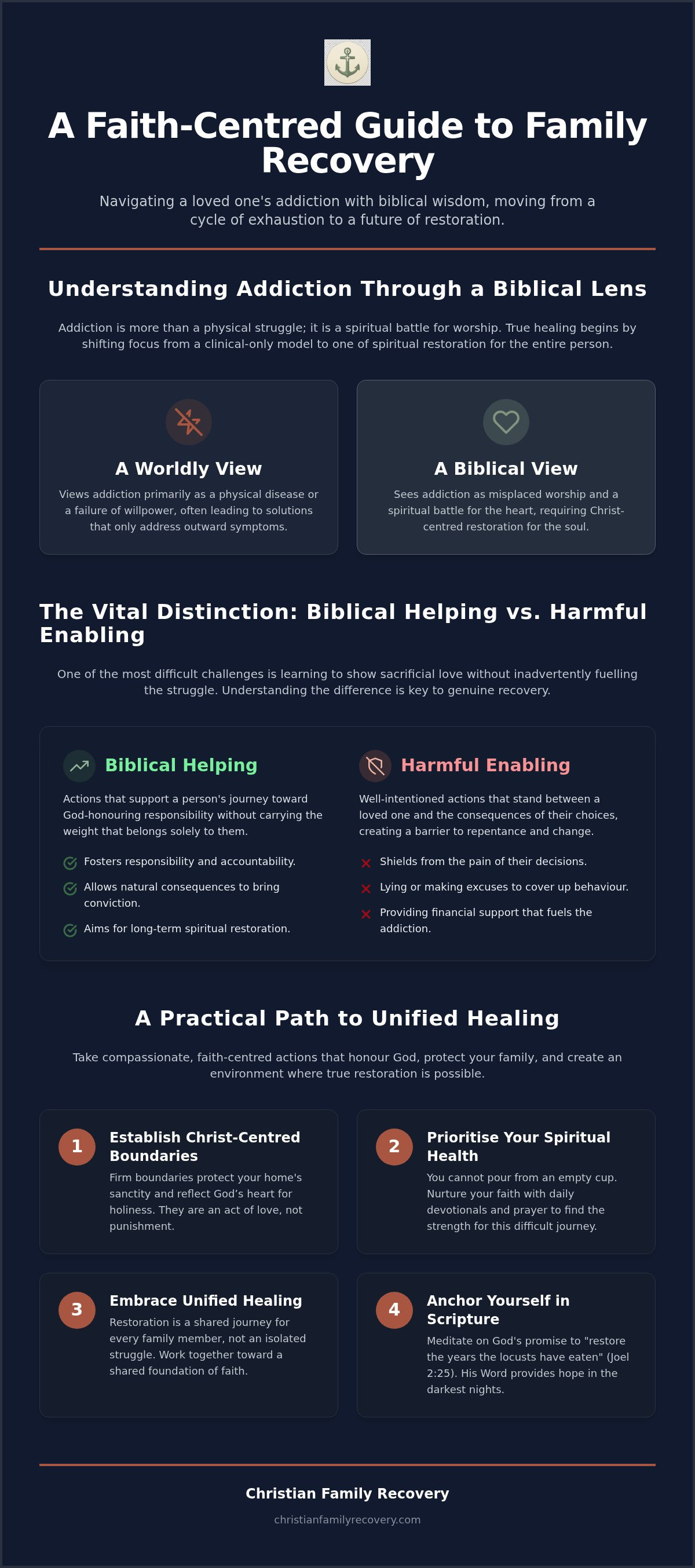
When you look at your loved one, you see more than a list of symptoms or a medical diagnosis. You see a soul in pain, a person created in the image of God who is currently lost in a fog of dependency. While the world often views this struggle strictly through a clinical lens, a biblical perspective reveals a deeper battle for worship. Addiction is essentially a struggle of the heart where a substance or behaviour has usurped God's rightful place. It's a misplaced search for the peace and comfort that only the Creator can truly provide.
Moving beyond a "disease only" model toward a "spiritual restoration" model allows you to address the root causes rather than just the outward signs. Historically, the Temperance Movement highlighted how faith and moral clarity could address the devastation of substance abuse. When you begin to understand how to help an addicted family member biblically, you realise that the goal isn't just sobriety; it's the restoration of the whole person. This shift in focus acknowledges that whilst the body is affected, the spirit is where the ultimate healing must begin.
Willpower often fails because it relies on the very human strength that addiction has already shattered. Faith-centred restoration provides a different path, offering a lasting freedom that comes from being anchored in Christ. This process involves the entire family unit, as the impact of sin and suffering ripples through every relationship in the home. It's a shared journey that requires a shared foundation of faith.
The Spiritual Battle in the Home
The enemy uses specific tools to keep families trapped in cycles of despair. Isolation silences the truth; fear paralyses the heart; discouragement drains the soul. These forces disrupt the God-ordained peace of your household, turning a place of refuge into a site of constant conflict. It's vital to remember that your own spiritual health is just as important as your loved one's recovery. You can't pour from an empty cup, and you can't guide them toward wholeness if you aren't walking that path yourself.
Scripture for the Heartbroken Family
God's Word is a lamp for the darkest nights. Meditating on Joel 2:25, where God promises to restore the years the locusts have eaten, can provide the hope you need to persevere. Understanding God’s heart for the suffering reminds you that He isn't distant or indifferent to your pain. Integrating daily devotionals into your prayer life ensures you're receiving the spiritual nourishment required for this journey. It turns your focus away from the immediate crisis and back toward the King who has the power to make all things new.
The Vital Distinction Between Biblical Helping and Enabling
Distinguishing between sacrificial love and harmful enabling is perhaps the most difficult part of learning how to help an addicted family member biblically. You want to be the hands and feet of Jesus, yet you often find yourself exhausted by a cycle that never seems to change. Enabling occurs when you stand between your loved one and the natural consequences of their choices. While it feels like mercy in the moment, it actually functions as a barrier to their repentance. Biblical helping, by contrast, is an act of restoration that supports a person’s journey toward God-honouring responsibility without carrying the weight that belongs solely to them.
When your entire existence revolves around managing another person's crisis, you risk falling into the "idolatry of the addict." This happens when your primary mission becomes "saving" them rather than seeking God's kingdom. By removing the pain of their choices, you might inadvertently hinder the very work God is doing in their life. Understanding The Science of Addiction helps us see how the brain's reward system is hijacked, but it doesn't negate the spiritual necessity of accountability. If you're unsure where your actions fall, our faith-based programmes offer a structured way to audit your household's dynamics and find a healthier path forward.
Signs You Are Enabling Biblically
It can be painful to admit that our "help" is actually fuelling the fire. You might be enabling if you find yourself:
- Lying or covering up: Making excuses to employers or other relatives to "protect" the family reputation whilst the behaviour continues in secret.
- Financial shielding: Providing money for "necessities" like rent or food that actually allows the addict to spend their own resources on their substance of choice.
- Prioritising comfort: Softening the blow of a relapse so they don't have to feel the sting of regret, which often stunts their character growth.
The Theology of Consequences
God uses the law of sowing and reaping as a powerful teacher. Galatians 6:7 reminds us that a man reaps what he sows; this isn't a punishment, but a divine mechanism for correction. Consider the Prodigal Son. He only came to his senses when he reached "the end of himself" amongst the pigs. If his father had sent him money to stay in the far country, the son might never have returned home. Balancing grace with truth means allowing your loved one to feel the weight of their choices so that they, too, might look upward for a solution that only Christ can provide.
Establishing Christ-Centred Boundaries and Tough Love
Many believe that unconditional love means unconditional access, but a biblical worldview suggests otherwise. Boundaries are not walls designed to shut someone out; they are fences intended to keep the sacred safe. When you are learning how to help an addicted family member biblically, you must mirror God's own character. He is perfectly merciful, yet He is also perfectly holy. He doesn't tolerate sin in His presence, and He often allows us to face the consequences of our choices to draw us back to Him. Setting a boundary is an act of stewardship over your home and your heart.
Saying "no" often triggers a deep sense of guilt, especially when you're told that you're being "un-Christian" or "judgmental." However, you must distinguish between the addict's desires and their actual needs. Whilst they may want financial relief or a place to hide their behaviour, what they need is a confrontation with the truth. While seeking help for substance use disorders is a vital part of the physical journey, the spiritual journey requires the family to stop subsidising the chaos. Protecting the weak members of your household, such as children or elderly parents, is a God-given mandate that must take precedence over the comfort of the one in active addiction.
Practical Boundaries for the Home
To move from confusion to clarity, you need concrete rules that protect the sanctity of the family unit. Consider these three areas:
- Financial boundaries: This means an immediate end to "loans" or paying bills that the loved one should be responsible for. It stops the flow of resources to the addiction.
- Behavioural boundaries: Clearly define what is acceptable in the family home. This might include a zero-tolerance policy for substances or illegal activity on the premises.
- Emotional boundaries: You must protect your own spiritual walk. This involves refusing to engage in circular arguments or allowing the addict's emotional state to dictate the atmosphere of the entire house.
Maintaining Boundaries Whilst Honouring Christ
The challenge isn't just setting the boundary; it's keeping it. Ephesians 4:15 calls us to "speak the truth in love," which means being firm about the facts whilst remaining soft in your delivery. Expect anger or manipulation as you change the "rules" of the relationship. When met with hostility, remember that you are fighting for their soul, not against their person. You don't have to walk this path alone. Seeking guidance from a Christian mentor or engaging in a structured programme can provide the external accountability you need to stay steadfast in your convictions.
Practical Steps for Supporting a Loved One’s Spiritual Recovery
Moving from the theory of biblical boundaries into daily practice is where the journey toward restoration truly begins. It's often a messy process, yet it's one that God uses to refine every person involved. Learning how to help an addicted family member biblically requires a move from passive observation to active, faith-led participation. You aren't just waiting for them to change; you're actively preparing the soil of your own heart for what God wants to do in your home. This sequence of steps provides a steady rhythm for families who feel overwhelmed by the weight of addiction.
- Commit to your own spiritual growth: You cannot lead your family toward a peace you haven't found yourself. Prioritise your daily devotionals to stay anchored in Christ's promises.
- Cease all enabling behaviours immediately: Once you've identified where you've been shielding them from consequences, prayerfully step back. This isn't an act of abandonment, but an act of trust in God's discipline.
- Invite them into a unified healing process: Instead of pointing fingers, offer a path where the family walks together. Our 8-Week Foundational Course provides the structured framework needed to begin this shared journey.
- Surround the situation with persistent prayer: Prayer is your primary weapon in this spiritual battle. It shifts the burden from your shoulders to the Lord's.
- Utilise faith-based tools: Embrace digital support systems that keep your focus on biblical truth throughout the day.
The Power of Persistent Prayer
Many families start by praying for God to "fix" the addict, but true breakthrough often comes through "surrender" prayer. This means releasing your desire to control the outcome and asking God to do whatever is necessary to bring your loved one to the end of themselves. Praying specific scriptures over your family member's heart, such as asking for the "scales to fall from their eyes," keeps your petitions aligned with God's will. It's about staying steadfast in the gap whilst waiting for His perfect timing, knowing that His heart for restoration is even greater than your own.
Leveraging Faith-Based Technology
In the heat of a crisis, you need guidance that is both immediate and biblically sound. A Personal AI Companion acts as a digital spiritual guide, offering scriptural wisdom 24/7 when human mentors might be unavailable. These tools, combined with self-paced digital programmes, allow for private family healing that doesn't require the immediate cooperation of the addicted individual. By using daily devotionals to keep your mind stayed on Christ, you ensure that the atmosphere of your home is defined by hope rather than the chaos of addiction.
Moving Towards Unified Family Healing and Restoration
Addiction is rarely an isolated event; it is a family-wide challenge that ripples through every relationship in the home. When you focus solely on "fixing" the individual, you overlook the deep wounds and spiritual exhaustion carried by everyone else. Understanding how to help an addicted family member biblically requires a shift toward the concept of Unified Healing. This means walking the path of restoration together, acknowledging that whilst the struggle is heavy, the burden-sharing makes the journey possible. By engaging in a synchronised process of spiritual growth, you move away from the exhaustion of daily crisis management and toward a lifestyle of spiritual mastery.
Building a home environment that fosters peace requires more than just the absence of substances. It requires the presence of Christ in every interaction. As you transition from a state of emergency to one of long-term stability, your focus shifts from survival to thriving. You aren't just reacting to the latest relapse; you are proactive in your spiritual walk, ensuring that the atmosphere of your house is defined by grace, truth, and firm biblical foundations. This shift in focus protects the family’s spiritual health regardless of the choices the addicted member makes.
The 8-Week Foundational Course for Families
For many, the hardest part is knowing where to begin. Our 8-Week Foundational Course is designed specifically for families seeking a structured, biblically-based path. This programme moves you away from the isolation of "keeping secrets" and into a supported, faith-centred journey. By utilising daily devotionals and a dedicated curriculum, your family begins to speak a shared spiritual language. This unity is a powerful deterrent to the enemy’s tactics of division. You’ll find that as you grow, the environment of your home changes, creating a stable ground where restoration can truly take root.
Finding Your New Identity in Christ
It’s easy to lose yourself in someone else’s struggle. You might have spent years identifying primarily as "the addict’s relative," but God calls you to something far greater. You are first and foremost a child of the King. Breaking the cycle of codependency means reclaiming your identity in Christ, independent of your loved one’s choices. For those ready to go deeper, our 17-Week Mastery Course offers the tools needed to sustain long-term family health and spiritual resilience.
Never forget that God is the restorer of all things. He doesn't just patch up old wounds; He creates something entirely new. Whilst the path ahead may seem long, you are not walking it alone. Trust in His timing, lean on His Word, and take the next step toward a future of freedom and wholeness for your entire family.
Embrace a Future of Restoration and Peace
You've moved from the exhaustion of "fixing" to the clarity of a biblical framework. By seeing addiction as a spiritual battle and boundaries as acts of love, you've started a journey that protects your family's peace. Understanding how to help addicted family member biblically means choosing a path of unified restoration where your own spiritual health is a priority. You are no longer just reacting to a crisis; you are walking a structured path toward wholeness.
You don't have to walk this difficult road on your own. We encourage you to begin your family’s journey to restoration with our 8-Week Foundational Course. This programme offers a biblical curriculum designed for unified family healing, including daily devotionals for consistent spiritual bread and 24/7 guidance through our Personal AI Companion. These tools are designed to keep your heart anchored in truth whilst you navigate the steps of recovery.
There is hope for your home, and there is freedom for your loved one. God remains the steadfast restorer of everything the locusts have eaten; trust that He is leading you toward a place of wholeness and light. Your family's story isn't over yet.
Frequently Asked Questions
Is it un-Christian to kick an addicted family member out of the house?
It isn't un-Christian to require a loved one to leave if their behaviour threatens the safety or spiritual peace of your home. In fact, setting such a boundary can be a profound act of love. By allowing them to face the reality of their choices, you're mirroring God's own discipline. It's about protecting the vulnerable in your family whilst refusing to subsidise a lifestyle that leads away from Christ's path.
How can I stop feeling guilty about my loved one’s addiction?
Guilt often stems from the false belief that you're responsible for another person's choices. You must remember that addiction is a battle for worship that occurs within their own heart. While you can offer support, you cannot control their will. Relinquishing this burden to God allows you to focus on your own spiritual growth. Peace comes when you realise your primary duty is to remain faithful to Christ's commands.
What are the best bible verses for someone dealing with an addicted child?
Focus on verses that highlight God's power to restore. Joel 2:25 is a cornerstone, promising that God can return what the locusts have eaten. Philippians 4:6-7 encourages you to trade your anxiety for prayer. For those wondering how to help an addicted family member biblically, Romans 15:13 offers a prayer for the God of hope to fill you with all joy and peace as you trust in Him during this journey.
How do I know if I am helping or enabling my addicted spouse?
Helping supports their journey toward responsibility, whereas enabling shields them from the consequences of their sin. If you find yourself lying to their employer, paying debts they incurred through addiction, or prioritising their immediate comfort over their character growth, you're likely enabling. True biblical help requires the courage to say "no" to the addiction so that you can say "yes" to the possibility of their eventual heart-level restoration.
Can an online Christian recovery programme really work as well as rehab?
A digital programme serves a different, vital purpose by focusing on the spiritual health of the entire family unit. While some require physical stabilisation elsewhere, an online programme provides the long-term biblical framework needed for lasting freedom. It allows you to integrate recovery into your daily life. Our 8-week foundational curriculum focuses on heart-level change and unified healing, which are often the missing pieces in traditional, fragmented approaches to recovery.
How do I talk to my family member about their addiction without starting a fight?
Timing and tone are essential when addressing addiction. Approach the conversation during a period of relative calm, rather than in the heat of a crisis. Use "I" statements to express how their behaviour affects you and the household peace. By speaking the truth in love, you maintain your stance without becoming combative. Focus on your desire for a restored relationship and a unified family rather than simply listing their failures.
What should I do if my loved one refuses to seek biblical help?
If they refuse help, your focus must shift toward your own spiritual walk and the health of your household. You cannot force someone to seek restoration, but you can choose to stop participating in the chaos. Continue to pray persistently and maintain the boundaries you've set. Often, it's the sight of a family member finding peace and strength in Christ that eventually draws the addicted person toward wanting that same freedom.
How does an AI companion help with biblical recovery guidance?
A Personal AI Companion provides immediate, 24/7 access to scriptural wisdom during the moments when you feel most overwhelmed. It acts as a digital mentor, offering guidance on how to help an addicted family member biblically when human support isn't available. Whether you're facing a midnight crisis or need a quick devotional thought to regain your peace, it ensures you're never walking the path of restoration in total isolation.