
What if the reason you keep stumbling isn't because you lack discipline, but because you've been relying on a power source that was never meant to carry this weight? You likely know the physical and mental exhaustion of "white-knuckling" your way through another day, only to fall back into the same patterns whilst feeling the crushing weight of shame. It's heartbreaking to feel like a "bad Christian" simply because your best efforts aren't enough to keep you sober. We understand this struggle deeply; it's a heavy burden to carry alone.
This article explains why willpower is a finite human battery that eventually runs dry and how true recovery through faith not willpower offers a path to lasting transformation. You'll discover how to stop the constant mental battle and replace it with a structured approach that puts Christ at the centre of your daily sobriety. We will explore how shifting your focus from self-reliance to spiritual restoration can finally bring the peace of mind and family reconciliation you've been praying for. You don't have to fight this battle with your own limited strength any longer.
Key Takeaways
- Understand why relying on human resolve leads to exhaustion and discover how to break the cycle of shame that follows a relapse.
- Learn why lasting transformation requires recovery through faith not willpower, shifting from self-reliance to an infinite spiritual power source.
- Reframe surrender as a position of strength that opens the door to restoration rather than a sign of defeat or weakness.
- Explore how a structured biblical curriculum and a personal AI companion can provide the daily support needed to walk the path of healing.
- Gain a practical roadmap for restoring family relationships and achieving true peace of mind through a unified, faith-centred approach.
The Exhaustion of Willpower: Why "White-Knuckling" Recovery Often Fails
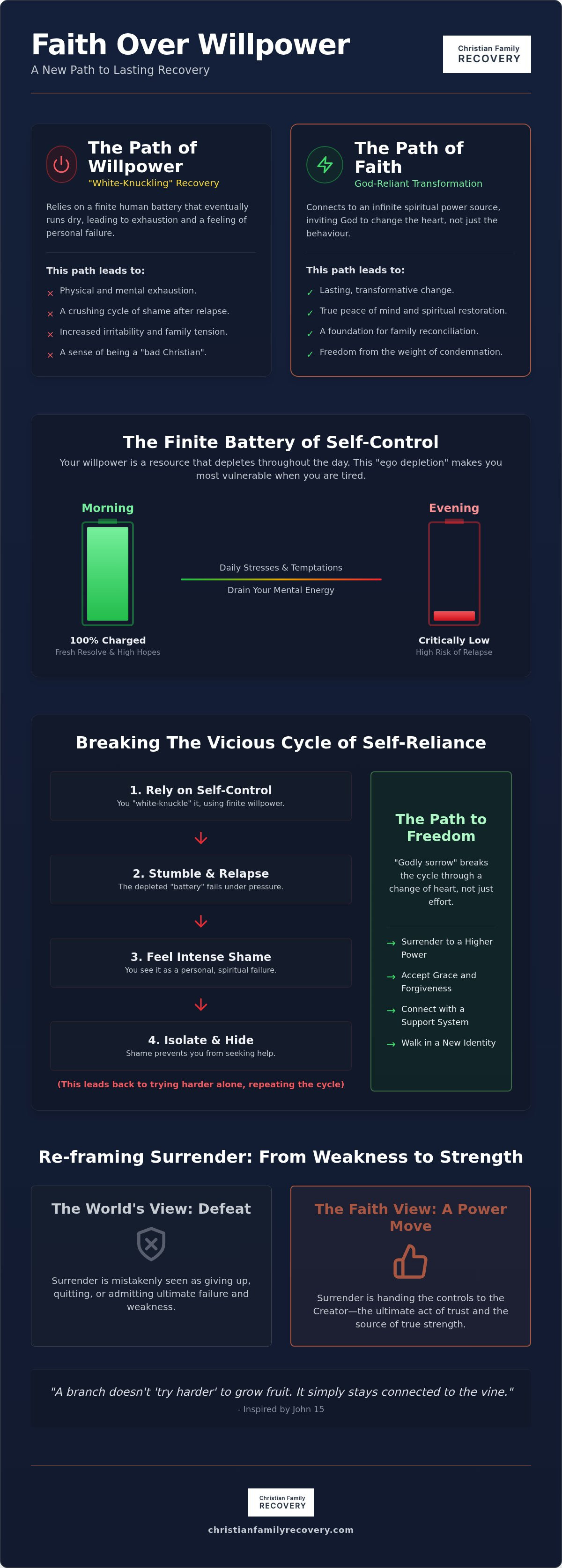
Many of us begin the journey of sobriety with a surge of determination. We promise ourselves, our families, and God that this time will be different. Yet, after a few days or weeks, that initial fire begins to flicker. Your best intentions aren't failing because you're a bad person; they're failing because they're being asked to do something they weren't designed to do. True recovery through faith not willpower acknowledges that human resolve has a strict limit. When we try to "white-knuckle" our way through cravings, we're essentially trying to hold back a flood with a wooden fence. It's exhausting, and eventually, the wood splinters.
The Finite Battery: Why Your Best Intentions Run Dry
Psychologists often talk about "ego depletion," which is a simple way of saying your self-control is a finite resource. Think of it like a mobile phone battery. In the morning, you're at 100 per cent. You resist the urge to shout in traffic, you stay focused at work, and you handle family stresses with patience. By 8:00 PM, your battery is at 5 per cent. This is why "day ten" of sobriety often feels so much harder than "day one." On day one, your enthusiasm is high and your battery is fresh. By day ten, you're mentally spent and physically on edge. Willpower is a temporary tool for short-term tasks, not a permanent foundation for a transformed life.
The physical and emotional toll of this constant effort is immense. You might experience:
- Increased irritability and "short fuses" with loved ones.
- A constant, nagging sense of mental fog or fatigue.
- Tightness in the chest and shoulders from staying "on guard."
- A feeling of being spiritually hollow despite your best efforts.
The Shame Cycle of Self-Reliance
When we rely solely on ourselves, every stumble feels like a personal indictment. This creates a vicious cycle of shame that fuels further isolation. You fail, you feel like a "bad Christian," and you hide your struggle because you believe you should be strong enough to handle it alone. This "worldly sorrow" leads only to despair and a deeper desire to numb the pain. In contrast, "godly sorrow" leads to a change of heart through repentance and connection. Even the spiritual principles of the Twelve Steps recognise that we must admit we are powerless before we can find true strength.
Traditional recovery often feels like a missing piece for the devout believer because it focuses on changing the behaviour without inviting the Healer to change the heart. Addiction is a spiritual and relational malady, not just a failure of self-discipline. By shifting your focus from "trying harder" to "trusting deeper," you move away from the exhaustion of self-reliance and towards the restorative peace of Christ.
From Self-Reliance to God-Reliance: The Spiritual Mechanics of Transformation
If willpower is a battery that runs dry, God-reliance is an infinite power grid. The transition from self-reliance to God-reliance isn't about giving up your effort; it's about re-aligning your source of strength. In the Greek New Testament, the word for power is dunamis, the root of our word "dynamite." This isn't just a gentle nudge. It's an explosive, transformative strength that exceeds human capacity. Embracing recovery through faith not willpower means admitting that whilst you cannot change yourself, God can. It's the difference between trying to push a heavy car uphill and simply turning on the engine.
Understanding Surrender as a Position of Power
Surrender is often misunderstood as a sign of defeat. In the world of faith, however, it's the ultimate power move. When you surrender, you aren't quitting; you're handing the controls to the Creator who knows exactly how you're wired. Jesus used the metaphor of a branch and a vine in John 15. A branch doesn't "try harder" to grow fruit. It simply stays connected to the vine. When you shift your focus from the "problem" of addiction to the "Provider" of your soul, your mental landscape changes. You stop staring at the mountain and start looking at the one who can move it.
The Role of Grace in Breaking Addiction’s Grip
Grace is the only force capable of silencing the voice of condemnation that keeps you trapped in the shame cycle. Whilst willpower demands perfection, grace offers a new identity. You're no longer defined as an "addict" struggling for sobriety; you're a child of God walking towards wholeness. This shift in perspective is backed by research, as the American Psychological Association has noted that spiritual engagement often leads to positive mental health outcomes like increased resilience and optimism.
Grace removes the crushing weight of perfectionism. If you stumble, grace doesn't cast you out; it invites you back to the path. You might wonder, is faith-based recovery effective? Evidence suggests that when the heart is transformed, the behaviour follows naturally. This is why our 8-Week Foundational Course focuses on these spiritual mechanics first, proving that true recovery through faith not willpower is a sustainable journey. By trusting deeper in God’s character rather than trying harder in your own strength, you find a peace that "white-knuckling" can never provide. You can begin to walk this path of restoration today, moving from the exhaustion of self-reliance to the security of God's strength.
Surrender vs. Weakness: Reclaiming True Power Through Faith
A common objection to faith-based healing is the idea that it's a "crutch" for those too weak to quit on their own. In reality, admitting that you cannot overcome addiction through your own strength is the most courageous act of honesty you can perform. It isn't a sign of defeat; it's a sign of profound wisdom. True recovery through faith not willpower is about acknowledging that whilst your human resolve is finite, God’s capacity for restoration is limitless. This isn't just a theological sentiment. An NIH study on spirituality and addiction recovery confirms that individuals with strong spiritual beliefs have significantly higher rates of remission, proving that this "weakness" is actually a foundation for measurable success.
Willpower vs. Faith: A Daily Comparison
The difference between these two paths is most evident in the heat of a moment of temptation. Willpower focuses on the "No," forcing you to scream at your desires until your mental voice goes hoarse. It's a battle of attrition that leads to "anxious effort." Faith, however, focuses on the "Yes" of God’s promises. Instead of staring at the void, you turn your eyes towards the Provider who fills it. This leads to a state of "restful obedience." You aren't fighting to stay sober in your own power; you're resting in the fact that God is holding you through the storm.
- Willpower Outcome: Mental exhaustion, constant vigilance, and a persistent "white-knuckle" fear of relapse.
- Faith Outcome: Peace of mind, a sense of being carried, and a heart that gradually loses interest in old behaviours.
Building Resilience Through Spiritual Disciplines
Whilst willpower burns out, faith builds resilience through the steady process of sanctification. This is the gradual healing of your heart and mind. By putting on "spiritual armour" through prayer and scripture, you create a protective barrier against the stresses of life. Our daily devotionals help you organise these disciplines into a sustainable routine. Instead of a chaotic struggle, your recovery becomes a structured path of growth. By integrating a Personal AI Companion into your day, you have a tool that helps maintain this God-centred perspective 24/7, ensuring that your resilience is rooted in His word rather than your own fluctuating moods. This structure moves you away from the frantic energy of "trying harder" and into the steady rhythm of walking with Christ.
Practical Ways to Organise Your Recovery Journey Around Faith
Moving from the exhaustion of self-reliance to the peace of God-reliance requires a practical shift in how you structure your day. It's about building a framework that supports your spirit before the world demands your energy. The first step is a humble acknowledgement: your own strength has failed, and you are now inviting God into the very centre of your struggle. This isn't a sign of defeat; it's an invitation for the Creator to do what you cannot. Once you've made this shift, you must immerse yourself in a structured biblical curriculum to relearn how to live, think, and react to life's inevitable pressures.
Renewing the Mind: The Daily Battle for Peace
Cravings usually begin as a whisper, a single thought that, if left unchecked, grows into a roar. Taking every thought captive is a skill that requires daily practice. By establishing a rhythm of prayer and devotion, you participate in the process of "renewing the mind" mentioned in Romans 12:2. These daily devotionals act as spiritual bread, providing the exact nourishment you need for that day's specific trials. Spending just 15 minutes in morning study can shift your entire day’s trajectory from a frantic struggle to a calm, focused walk with Christ. This is the practical reality of recovery through faith not willpower; you are no longer fighting a solo war, but walking a path already paved with grace.
Creating a Sanctuary for Healing at Home
Healing doesn't always require a clinical setting or an impersonal institution. In fact, many find that an Online 8-Week Addiction Recovery Programme provides a safer, more private environment for deep transformation. By choosing a home-based approach, you can maintain family unity whilst setting firm boundaries with external triggers. This allows you to process your healing in a space of security rather than a place of judgement. To maintain this connection 24/7, we use modern tools like a Personal AI Companion, ensuring that biblical principles are always within reach when a crisis hits. You can begin building your sanctuary today by choosing a programme designed for your life and your faith.
Walking the Path Together: How a Structured Biblical Curriculum Supports Your Healing
The journey towards lasting sobriety is rarely successful when walked in isolation or without a clear map. If you've spent years trapped in the "shame cycle," you know that good intentions aren't enough to sustain you when life's pressures mount. True recovery through faith not willpower requires more than just a desire to change; it requires a structured environment where your spirit can be nurtured and your mind can be systematically renewed. We don't offer a clinical fix or a temporary patch. Instead, we provide a guided path that invites you to stop the exhausting struggle of self-reliance and start a synchronized journey towards wholeness.
The 8-Week Foundational Path
Our 8-Week Foundational Course is designed as a roadmap for those ready to move from the chaos of crisis into the security of spiritual stability. This curriculum doesn't rely on clinical therapy or medical jargon. It focuses entirely on biblical principles that address the heart, the mind, and the family unit. When you stop "trying" to be sober in your own strength and start "following" the steps laid out in God’s Word, the mental landscape begins to shift. You’ll move through a sequence of steps that help you:
- Identify the spiritual roots of your struggle.
- Establish daily habits that anchor your peace in Christ.
- Rebuild trust within your family through honest, faith-centred communication.
- Replace the identity of an "addict" with the identity of a redeemed child of God.
24/7 Support: Your AI Companion on the Journey
One of the greatest challenges in recovery is the "midnight moment"—those times when temptation strikes and you feel completely alone. Whilst traditional groups meet once a week, your struggles happen in real-time. This is why we've integrated a Personal AI Companion into our programme. This tool provides 24/7 biblical guidance, helping you apply specific scriptures to your immediate situation. Whether you're feeling a sudden craving or simply need a devotional word to steady your heart, this resource is always at your fingertips. It is a non-judgemental, biblically-grounded presence that ensures you never have to walk a single hour in isolation.
Healing is a unified process. It isn't just about the individual staying sober; it's about the restoration of the entire family. By walking this path together, you and your loved ones can experience a shared transformation that willpower could never achieve. You were never meant to carry this burden alone. By embracing recovery through faith not willpower, you step into a partnership with the Creator who has already promised to give you the strength you lack. You can begin this guided journey today, moving out of the darkness and into the light of a restored life.
Step Into a Life of Lasting Restoration
You've likely spent too long fighting a battle with a weapon that was never designed for victory. Relying on your own resolve only leads to exhaustion and the heavy burden of the shame cycle. True recovery through faith not willpower begins when you trade the frantic effort of "trying harder" for the restful security of trusting God's infinite strength. By shifting your focus from the problem to the Provider, you open the door to a transformation that reaches the very depths of your heart.
This guided path ensures you don't have to navigate the journey alone or in secret. Our structured 8-Week Foundational Course provides a clear roadmap for spiritual restoration, supported by daily devotionals and a 24/7 AI Companion for real-time biblical guidance. This isn't just about stopping a behaviour; it's about reclaiming your identity and restoring your family relationships through a shared, faith-centred experience.
Begin your journey to freedom with our 8-Week Foundational Course today.
There is hope for a future defined by peace rather than struggle. Your restoration is possible, and it starts with a single step of faith.
Frequently Asked Questions
How is faith-based recovery different from traditional 12-step programmes?
Faith-based recovery centres on a personal relationship with Christ and biblical transformation rather than a generic "Higher Power." Whilst traditional 12-step programmes provide valuable community, our approach focuses on the heart's renewal through scripture and the Holy Spirit. We move away from the "once an addict, always an addict" mindset, instead embracing a new identity in Christ. This structured path prioritises spiritual restoration as the primary driver of lasting sobriety.
Can I really recover from addiction through faith if I have failed many times before?
Yes, because previous failures often stem from relying on finite human resolve. Achieving recovery through faith not willpower means you stop depending on your own strength and start leaning on God’s infinite power. Failure in the past doesn't define your future when you invite the Holy Spirit to transform your desires. By following a structured biblical curriculum, you replace old habits with spiritual disciplines that provide the resilience needed to stay the course.
Do I need to be a member of a specific church to join your recovery programme?
No, you don't need to belong to a specific church or denomination to enrol in our programmes. Our ministry is designed to support any individual or family seeking a biblical path to freedom from addiction. The 8-week foundational course is accessible online from anywhere in the world, allowing you to focus on your spiritual growth in a private, home-based setting. We welcome anyone ready to walk the path of restoration.
Is an online recovery course as effective as an in-person support group?
Online recovery is highly effective because it offers a level of privacy and 24/7 support that in-person groups often cannot match. Whilst meetings happen at set times, temptations occur at any hour. Our digital platform provides constant access to a Personal AI Companion and daily devotionals, ensuring you have biblical guidance exactly when you need it. This home-based approach also allows for a more unified family healing process without the fear of public judgement.
What happens if I feel my willpower slipping during the 8-week course?
If you feel your resolve wavering, you should immediately turn to your Personal AI Companion for real-time biblical encouragement. The 8-week course is specifically designed to move you away from the "white-knuckle" struggle of willpower. When you feel weak, it's an invitation to lean deeper into God’s grace. Our curriculum teaches you how to take every thought captive and find strength in Christ’s power rather than your own fluctuating moods.
How does the AI companion provide biblical guidance for my specific addiction?
The Personal AI Companion acts as a 24/7 spiritual guide that applies specific biblical truths to your immediate struggles. Whether you're facing a craving, feeling isolated, or dealing with family conflict, the AI offers scripture-based insights tailored to your situation. It helps you navigate the practical mechanics of recovery through faith not willpower by providing a non-judgemental space to process thoughts and receive encouragement rooted in the Word of God at any hour.
Can my family be involved in my faith-based recovery journey?
Family involvement is a central pillar of our recovery philosophy. We believe that addiction is a relational malady, so healing should be a unified journey for the entire household. Our programmes provide a structure that helps families rebuild trust and communicate through a shared biblical perspective. By walking the path together, you and your loved ones can experience collective restoration, ensuring that the home becomes a sanctuary of support rather than a place of stress.
What does the Bible say about addiction and the limits of human willpower?
The Bible acknowledges that our human nature is prone to struggle, as seen in Romans 7 where Paul describes doing the very things he hates. Scripture teaches that whilst our "flesh" is weak, the Spirit provides the power we lack. It emphasises that we are not meant to carry heavy burdens alone. True freedom comes from surrender and the renewal of the mind, shifting our reliance from self-discipline to the transformative grace found in Christ.